

The Software Engineer Interview Process in 2026: Every Stage
Back with another one in the series where I break down the things I wish someone had mapped out for me clearly. This time it is not an algorithm. It is the whole software engineer interview process, end to end, as it actually runs in 2026.
I have been on both sides of this table. I have failed interviews because I walked in not knowing what the next stage even was, and I have since helped a lot of engineers prep through Levelop. The single most common thing I see is not weak coding. It is people who are surprised by the structure. They prep hard for the coding round, then get blindsided by a system design loop or a behavioral panel they did not know was coming.
So here is the full map. Every stage, what it is testing, how long it takes, and what changed now that AI sits in the middle of all of it.
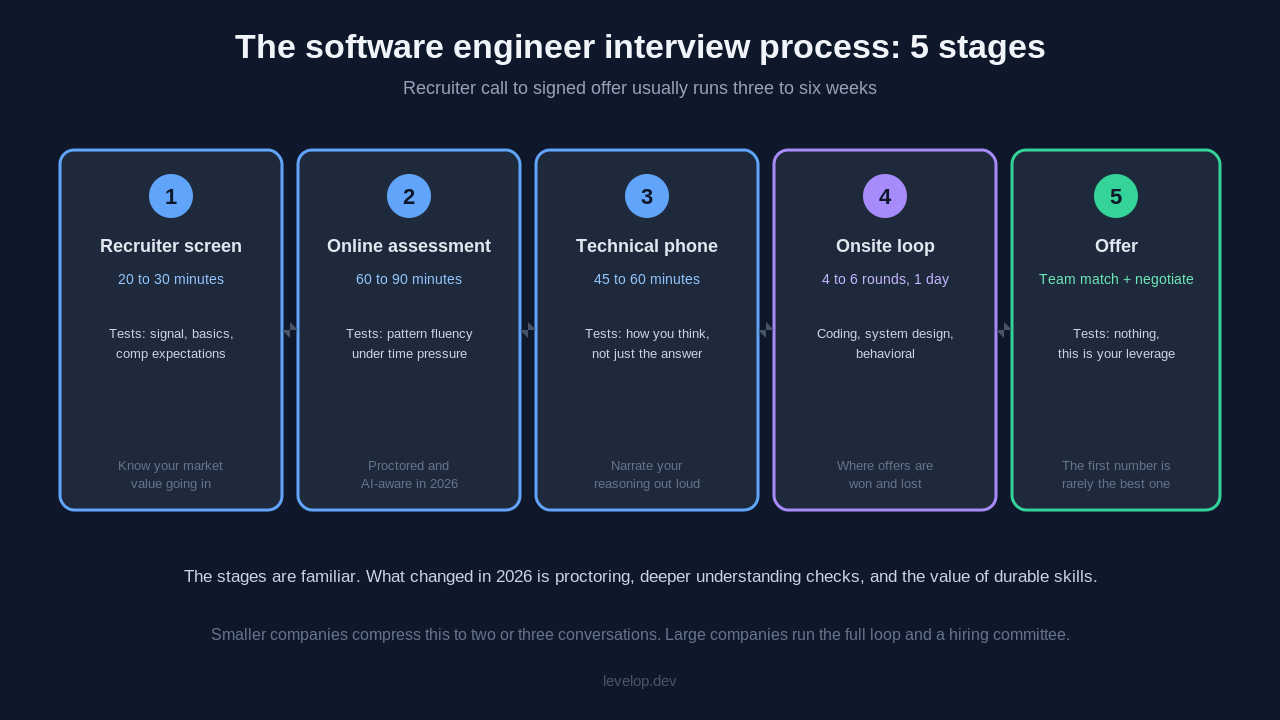
The shape of the process in 2026
Most software engineer interview processes still follow the same skeleton they have for years. The number of rounds changed a little, and the way some rounds are run changed a lot, but the stages are recognizable:
- Recruiter screen
- Online assessment or take-home
- Technical phone screen
- The onsite loop (coding, system design, behavioral)
- Team match, offer, and negotiation
A typical timeline runs three to six weeks from first recruiter call to offer. Bigger companies skew longer because of scheduling and committee review. Startups can compress the whole thing into a single week for a candidate they are eager to hire.
The honest version: not every company runs all five stages. A 30-person startup might do a recruiter call, one technical conversation, and a founder chat. A large company will run the full loop and then some. Knowing which version you are in changes how you prep, so the first thing I do now is ask the recruiter how many rounds there are and what each one covers. Recruiters will share this when asked, and many candidates forget they can ask.
Stage 1: The recruiter screen
This is a 20 to 30 minute call, and the biggest mistake is treating it as a formality. It is not pass-fail on technical depth, but it is absolutely pass-fail on signal. The recruiter is checking three things: are your basics real, do your salary expectations fit the band, and are you going to be a pain to schedule.
What they actually ask: a walk through your background, why you are looking, what you want next, and your compensation expectations. That last one trips people up. If you anchor too low you cap your own offer before you have done a single technical round. If you refuse to give any number you sometimes stall the process. I usually give a range based on real market data and say I am flexible for the right role.
I dig into how to actually read a compensation band in how to evaluate a tech compensation package beyond the base salary.
The thing that changed in 2026: recruiters increasingly screen for whether you can think without an AI assistant in front of you. Some now ask a quick conceptual question on the call itself, not to trap you, but because so many candidates have only ever coded with autocomplete doing half the work.
Stage 2: The online assessment
After the recruiter, a lot of companies send an automated coding assessment, usually on HackerRank, CodeSignal, or a similar platform. You get two to four problems and a fixed window, often 60 to 90 minutes. Some companies use a take-home project instead, which gives you a few days but expects production-quality code.
This stage is mostly a filter. The signal is binary for a lot of teams: did you pass enough test cases. That is why pattern fluency matters more here than cleverness. You are not trying to impress anyone, you are trying to clear the bar quickly and cleanly.
A clean approach under time pressure usually looks like this. Read all the problems first, do the easy one fast, then spend your remaining time on the harder one:
# Triage approach: confirm the easy win before sinking time into the hard problem.

def solve(problem):
    brute = brute_force(problem)        # correct but slow, get SOMETHING passing
    if time_left() > THRESHOLD:
        return optimize(brute)          # only optimize once a baseline passes
    return brute                        # a passing brute force beats an elegant timeout
The 2026 wrinkle is proctoring. Because AI tools made cheating trivial, assessment platforms now layer in webcam monitoring, tab-switch detection, and keystroke analysis. Plenty of companies also moved away from pure auto-graded puzzles toward formats that are harder to fake. I wrote about that shift in why companies are moving from solve this problem to explain this code.
Stage 3: The technical phone screen
This is a 45 to 60 minute live conversation with an engineer, usually over a shared editor like CoderPad. One or two problems, and the difference from the OA is that someone is watching how you think.
Here is what I missed for a long time: the phone screen is not primarily a coding test. It is a communication test that happens to use code. The interviewer cares whether you take time to understand the problem, ask clarifying questions, state your assumptions, talk through tradeoffs, and recover gracefully when you hit a wall. You can write working code and still fail this round by going silent for fifteen minutes.
The structure that works for me, every time:
1. Restate the problem in my own words
2. Ask clarifying questions (input size, edge cases, constraints)
3. State a brute-force approach out loud
4. Improve it, explaining the tradeoff at each step
5. Code the chosen approach while narrating
6. Test it on a small example by hand
That narration is the whole game. The interviewer is taking notes on your reasoning, not just your final answer. A correct solution arrived at silently scores worse than a slightly imperfect one where they could follow every decision.
The patterns that show up here are not infinite. Two pointers, sliding window, BFS and DFS, dynamic programming, and a handful of others cover the overwhelming majority of phone-screen interview questions. If you want a concrete sense of how interviewers now probe understanding rather than memorized solutions, Google coding interviews in 2026: what changed and what didn't is a good read.
Stage 4: The onsite loop
This is the real evaluation. Despite the name, most onsites in 2026 are virtual, run over video across four to six back-to-back rounds in a single day. For many candidates this is the most exhausting part, not because any single round is brutal, but because you have to stay sharp for five hours straight.
The loop usually breaks into three kinds of rounds.
Coding rounds (two to three)
Harder versions of the phone screen. Multiple problems, deeper follow-ups, and interviewers who push on optimization and edge cases. The bar is not merely a working solution, it is a working solution with clear complexity analysis and clean code you can defend.
System design round (one to two)
For mid-level and senior software engineer candidates, this is where offers are won and lost. You get one of the classic system design questions, an open-ended prompt like design a URL shortener or design a news feed, and 45 minutes to drive the conversation. The interviewer wants to see you scope requirements, estimate scale, sketch a high level design of the components, and reason about tradeoffs in distributed systems around consistency, caching, and failure.
The mistake I made early was jumping straight to a database schema. The strong move is to spend the first ten minutes on requirements and back-of-envelope math before you draw a single box. Nail down read versus write ratios, expected QPS, and storage growth first. Everything downstream depends on those numbers.
Behavioral round (one)
Often underrated, sometimes decisive. The interviewer asks about conflict, failure, leadership, and ambiguity, and they are listening for whether your stories are specific and whether you take ownership. The STAR structure, situation, task, action, result, exists because it forces specificity. Vague stories sink this round.
A small thing that helps: prepare six to eight real stories from your own work and map them to the common themes ahead of time. You are not memorizing scripts, you are making sure you can reach for a concrete example instead of freezing.
Stage 5: Team match, offer, and negotiation
If you clear the loop, some companies route you to team matching, where you talk to managers to find a fit. Then the recruiter comes back with an offer.
This is the stage people leave the most money on the table, because by now they are relieved and want it to be over. The first number is rarely the best number. Competing offers, market data, and a calm willingness to ask are what move it. I broke down the exact approach that worked for me in the salary negotiation script that got me a 35% higher offer, and if you are early-career with little leverage, your first salary negotiation covers that case specifically.
What actually changed in 2026
The stages are familiar, but the way they are run shifted because of AI. Three changes matter most.
First, proctoring got serious. Take-homes and online assessments now assume you have AI tools available, so they either watch you closely or design problems where an AI answer is obvious and disqualifying.
Second, the questions moved up a level. Because AI can generate a working function from a prompt, interviewers care less about whether you can produce code and more about whether you understand it. Expect more code-reading, debugging, and explain-this-design prompts. The whole arms race between cheating tools and detection systems is its own story, which I get into in the AI interview arms race.
Third, the durable skills got more valuable, not less. Communication, judgment, system reasoning, and debugging are exactly the things AI cannot fake for you in a live conversation. How to prep for AI-era interviews is the companion piece on what to actually build.
Common mistakes I see people make
Over-indexing on coding and ignoring system design. People grind hundreds of coding problems and walk into the design round having never drawn an architecture diagram. At mid-level and above, the design round often carries more weight than a coding round.
Going silent. The interviewer cannot give you credit for thinking they cannot hear. Narrate even when you are stuck. "I am considering a hashmap here but I am worried about the space cost" is a sentence that earns points.
Treating the behavioral round as filler. Strong technical candidates get rejected on culture and communication signal all the time. Prepare your stories with the same seriousness as your algorithms.
Accepting the first offer. You did the hard part already. A single calm email asking whether there is flexibility is the highest hourly-rate work you will ever do.
A realistic week-by-week timeline
It helps to see the whole thing on a calendar instead of as a list of rounds. Here is roughly how a four-to-six week software engineer interview process tends to play out in the real world.
Week one is the recruiter screen and, usually within a day or two of clearing it, the online assessment lands in your inbox with a deadline a few days out. Week two is the technical phone screen, often scheduled within a week of passing the assessment. Weeks three and four are where the onsite loop gets booked, and the scheduling itself can add a week of waiting because you are coordinating four to six different interviewers' calendars. Weeks five and six cover the hiring committee or debrief, team matching, and the offer conversation.
The lesson I learned the hard way is that the gaps between stages are not dead time. They are your prep windows. The week between the phone screen and the onsite is the single best stretch to drill system design interviews and rehearse your behavioral stories, because you finally know exactly what is coming.
Building a realistic technical interview prep plan
If you are starting from zero, do not try to prepare for every stage at once. Good technical interview prep is sequenced, and it mirrors the order the stages actually arrive in.
Start with problem solving fundamentals and the core data structures, because they carry the online assessment and the early coding rounds. Drill the core patterns until recognizing them is automatic. The goal is not to memorize solutions, it is to build the kind of pattern recognition that lets you map a new problem to one you already understand. That transfer is what separates someone who freezes on a fresh prompt from someone who calmly says "this is a sliding window problem."
Once the patterns feel routine, shift weight toward system design interviews and the core system design concepts behind them. This is the part most candidates underprep, and it is also the part that uses the most real world judgment. There is rarely one correct answer. The interviewer is watching how you reason about tradeoffs under real world constraints like cost, latency, and the team that has to maintain whatever you propose. Practicing a few canonical prompts out loud, end to end, builds the muscle far faster than reading design articles passively.
Save the behavioral prep for last, but do not skip it. A weekend of writing out real stories from your own work, mapped to conflict, failure, and leadership, is usually enough. The mistake is treating it as an afterthought you improvise on the day.
The thread running through all of this is that the modern software engineer interview rewards understanding over recall. You can see it in every stage: the recruiter probes whether your basics are real, the coding rounds probe whether you understand your own solution, and the design round probes whether you can reason about a system you have never built. Prep that builds genuine understanding, not memorized answers, is what holds up under that kind of pressure.
Frequently asked questions
How long does the software engineer interview process take in 2026?
Usually three to six weeks from the first recruiter call to a written offer. Large companies trend toward the longer end because of scheduling and hiring committee review, while startups can run the entire process in under a week.
How many rounds are in a typical software engineer interview?
Most full processes have four to six total touchpoints: a recruiter screen, an online assessment, a technical phone screen, and an onsite loop of three to five rounds. Smaller companies compress this, sometimes into two or three conversations.
What is the hardest stage of the interview?
For mid-level engineers and above, the system design round is usually the deciding factor and the one people are least prepared for. For entry level and early-career candidates, the coding rounds carry the most weight. Either way, the behavioral round rejects more strong technical candidates than people expect.
Can I use AI tools during the interview?
During live rounds, no. Proctored assessments now detect AI use and treat it as disqualifying. The bigger shift is that interviews are increasingly designed around understanding and explanation, which AI cannot do for you in real time. Use AI to study and practice, not to answer during the actual evaluation.
How should I prepare for each stage differently?
Coding rounds reward pattern fluency, so drill a small set of patterns rather than grinding random problems. System design rewards structured reasoning, so practice a few templates until they are automatic. Behavioral rounds reward specificity, so write out real stories in advance. The recruiter screen and offer stages reward knowing your market value before you are asked for a number.
The clearest way to get comfortable with all of this is to practice the stages the way they actually run, not in isolation. I have been building that structured path on Levelop, and most of the prep angles above came out of working through interview loops there. You can find more breakdowns like this on the Levelop blog.