
AI Code Review vs Human Code Review: What AI Catches and What It Misses
The debate over AI code review vs human code review is no longer theoretical. In 2026, AI generates code at a large share of every codebase, and that flood has to be checked somehow. Teams are now asking a sharper question. Not whether to use AI review, but where the machine wins, where the person wins, and what changes when both are in the loop.
This guide answers that directly. It compares AI code review and human code review side by side. It shows what each one catches, what each one misses, and how the code review process shifts once an AI reviewer joins the team. This is one of the biggest software development workflow changes of the year. If you ship code or approve pull requests, this is the tradeoff worth understanding.
Some people frame it as AI vs human code review, as if one has to lose. That framing is wrong. The real story is a division of labor. The machine takes the mechanical pass. The person keeps the judgment. What changes is the boundary between those two jobs.
AI code review vs human code review at a glance
Before the detail, here is the short version. The two approaches are good at different things, and the gap between them is the whole point.
A human reviewer brings context, intent, and product sense. They know why the ticket exists. They know which tradeoffs your team has already argued about. They get tired, they get busy, and they cannot read a hundred files at 6pm without missing something.
An AI reviewer brings speed, consistency, and patience. It reads every line of every diff at the same level of attention. It never skips a file because the sprint is ending. It also lacks any real sense of your business, your roadmap, or what the change is actually for.
What AI code review catches
Start with the strengths, because they are real and they are why adoption moved so fast. If you want the full primer on how the practice works, our AI code review developer's guide covers the basics. Here we focus on the comparison.
Common bug classes
AI review is excellent at the mistakes that repeat across every codebase. Off-by-one errors, missing null checks, unclosed resources, swallowed exceptions, loops that never exit, and edge cases a human forgets to test. These are the bugs a tired human skims past on the hundredth file. A model reviewing code does not get tired.
Here is the kind of bug an AI reviewer flags that a human often misses late in a long review.
# AI reviewer flags: connection is never closed on the error path
def fetch_user(db_url, user_id):
    conn = connect(db_url)
    row = conn.query("SELECT * FROM users WHERE id = ?", user_id)
    if row is None:
        return None          # leak: conn stays open
    conn.close()
    return row
A human reviewer reading forty files might wave this through. An AI reviewer catches the leaked connection every single time, because attention does not decay for a machine.
Coding standards and consistency
AI review enforces conventions across a large team without anyone playing style police. Name a rule once, and the reviewer applies it everywhere, in every pull request, forever. That is a job humans hate and do inconsistently. Handing it to the machine frees senior engineers to spend their review time on design instead of formatting.
Obvious security issues
AI review reliably catches hardcoded secrets, plain injection risks, and unsafe defaults. Tools that pair the model with proven static analysis, like the ones we compare in our best AI code review tools roundup, push accuracy higher on vulnerability findings. This is a clear win over a rushed human pass.
Speed at scale
The biggest AI advantage is throughput. An AI code review tool comments in real time, on every pull request, around the clock. When AI coding agents write half your code, a human-only review process simply cannot keep up. For large engineering teams, review becomes the bottleneck, and AI is how you widen it.
What human code review catches
Now the other side. Humans hold the parts that matter most, and no current tool closes this gap.
Intent and correctness of purpose
A human reviewer knows what the change is supposed to do. They can tell that the code works but solves the wrong problem. An AI reviewer checks whether the code is internally correct. It cannot check whether the code matches what the ticket actually asked for, because it does not know the ticket, the customer, or the conversation in standup.
Business and product context
People know that a slow query is fine here because the table has fifty rows. They know that a certain edge case never happens because of how the product is sold. They can weigh a tradeoff against the roadmap. An AI reviewer treats every line in a vacuum. It flags the slow query, misses that it does not matter, and stays silent on the design choice that will hurt you in six months.
Architecture and cross-cutting concerns
Weaker AI tools read only the diff, so they cannot see that your change breaks a contract in another service. Whole-codebase tools handle this better, but even they miss the human-level question of whether the architecture should change at all. Should this be a new service or a new function? Does this pattern fit how the team builds? That is design review, and it stays with people.
Mentorship and team growth
Human review teaches. A senior engineer leaves a comment that helps a junior get better, not just a comment that fixes a line. Review is how teams transfer knowledge and build shared standards. An AI reviewer corrects code. It does not grow your people. This is the part teams underrate most when they imagine AI replacing reviewers.
What changes when you add an AI reviewer
This is the heart of the comparison. Adding AI review does not just speed up the old process. It changes what human reviewers do.
Humans move up the stack
When the AI clears off-by-one errors and style nits, humans stop spending review time on them. The human pass shifts toward intent, design, and risk. Reviewers read fewer lines and ask better questions. The job gets more senior, not less needed.
Review becomes two passes, not one
The new default is a layered flow. The AI reviews first and handles the mechanical pass. The human reviews second and handles meaning. This mirrors the rule large teams adopted in 2026. After a six-hour outage on its main store in March 2026 linked to a bad deployment, Amazon told junior and mid-level engineers to get a senior sign-off before shipping AI-assisted changes, and added two-person approval for major changes to roughly 335 mission-critical systems. The lesson was not that AI is bad. It was that AI output needs a human gate.
The risk of automation bias
Here is the change nobody warns you about. When an AI reviewer approves a change, humans tend to trust it. They skim instead of read. That is automation bias, and it is dangerous on exactly the changes that matter most. The fix is a rule, not a hope. Decide which changes always need a real human read no matter what the AI says. High blast radius changes always do.
Noise management becomes a real job
A noisy AI reviewer trains your team to ignore it. They learn to dismiss comments, and then they miss the real warning buried in the false ones. Precision matters more than raw recall for daily use. Part of the new workflow is tuning the tool so people keep trusting it. We cover the config side in our guide to setting up AI code review in a GitHub CI/CD pipeline.
A side-by-side comparison
Here is the practical breakdown of who wins where.
- On speed, AI wins by a wide margin. Seconds versus hours.
- On consistency, AI wins. It applies the same standard every time.
- On common bugs, AI wins. It never gets tired or distracted.
- On obvious security issues, AI wins. On subtle logic-based vulnerabilities, humans win.
- On intent and correctness of purpose, humans win. The model does not know the goal.
- On business and product context, humans win. The model does not know your customers.
- On architecture and design, humans win. The model checks code, not whether the code should exist.
- On mentorship, humans win. The model corrects, it does not teach.
- On cost and scale, AI wins. One reviewer that never sleeps beats hiring for review volume.
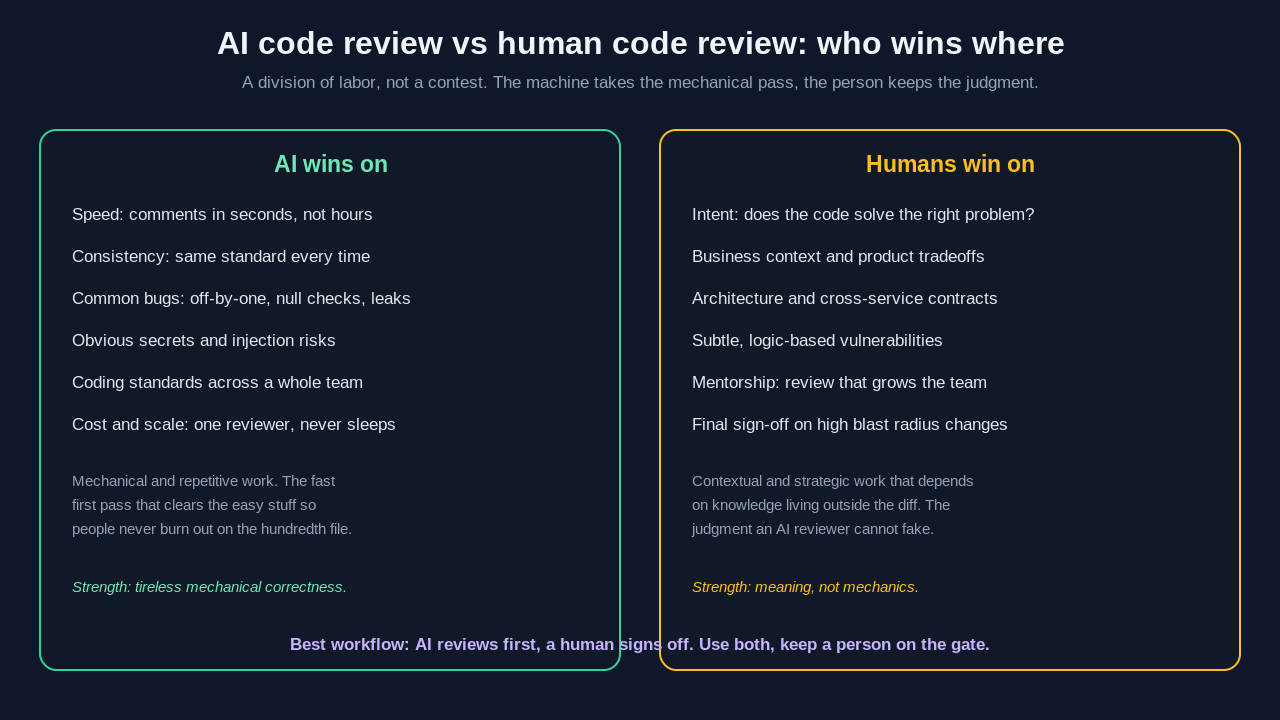
The pattern is clear. AI owns the mechanical and the repetitive. Humans own the contextual and the strategic. The teams that get this right do not pick a side. They assign each job to the reviewer built for it.
Can AI replace human code reviewers?
Short answer, no, and the framing misses the point. AI replaces the boring part of review, not the reviewer. The reviewer's job changes from catching typos to catching the things only a person can catch.
The strongest setup pairs an AI reviewer for the first pass with a human for the final decision. The AI makes the human faster by clearing the mechanical work. The human keeps the judgment that the AI cannot fake. Remove either side and quality drops. Remove the human, and you ship code that is internally correct and strategically wrong. Remove the AI, and review becomes the bottleneck that slows your whole team.
This is also why review skill is rising in value, not falling. As AI writes more code, the engineer who can review well becomes more important. If you are preparing for interviews, note that companies are shifting toward review-style questions too. Our piece on why companies are moving from solve this problem to explain this code covers that trend.
How to run a hybrid review workflow
Start with one repository. Turn on AI review and watch the comments for two weeks before you trust them. Tune what the tool flags so the signal stays high.
Set a clear gate. Decide which changes need human sign-off no matter what the AI says. Anything that can take down production qualifies. This is the Amazon model, and it is the right one.
Split the work on purpose. Let the AI handle the mechanical pass. Tell your human reviewers to skip the nits the AI already caught and spend their attention on intent, design, and risk. That is where people add value the machine cannot.
Watch for automation bias. If your team stops reading because the AI approved, your gate is broken. Measure how often humans override the AI, and treat that number as a feedback loop on the whole code review process. If it is never, they are rubber-stamping.
Treat AI review as one layer in a stack that still includes tests, static analysis, and human judgment. For the data-flow side of sending code to third-party tools, see our note on MCP security risks. For the bigger picture on AI-assisted development, our guide on what AI coding agents are sets the context.
Frequently asked questions
What is the difference between AI code review and human code review?
AI code review uses a language model to read a pull request and flag bugs, security issues, and style problems in seconds. Human code review uses an engineer's judgment to check intent, business context, and design. AI is faster and more consistent on mechanical issues. Humans are stronger on meaning and tradeoffs. The two cover different gaps, which is why most teams now use both.
Can AI code review replace human reviewers?
No. AI handles the repetitive first pass well, but it cannot judge whether code solves the right problem, fits your roadmap, or matches your architecture. The strongest workflow pairs an AI reviewer for the first pass with a human who makes the final decision. AI changes the reviewer's job, it does not remove it.
What does AI code review catch that humans miss?
AI reliably catches common bug classes like off-by-one errors, missing null checks, resource leaks, and swallowed exceptions, especially late in a long review when a human's attention fades. It also enforces coding standards consistently across every pull request and flags obvious secrets and injection risks that a rushed human pass can skip.
What do human reviewers catch that AI misses?
Humans catch intent mismatches, where code works but solves the wrong problem. They catch business-context issues, like a tradeoff that hurts the roadmap, and architecture problems that depend on knowledge outside the diff. They also mentor teammates through review, which transfers knowledge that an AI reviewer cannot.
Is it safe to merge code that only an AI reviewed?
Not for anything important. On critical or high blast radius changes, keep a human gate. Let the AI review first, then have an engineer sign off before merge. This is the approach large teams like Amazon adopted in 2026 after AI-linked outages. Auto-merging AI-approved changes invites automation bias, where people stop reading because the machine said it was fine.
The bottom line
The AI code review vs human code review question has a clear answer in 2026, and it is not a winner. AI owns the mechanical pass, speed, consistency, and the common bugs. Humans own intent, context, architecture, and the judgment that keeps you from shipping the wrong thing fast. What changes when you add AI is the human's job, which moves up the stack toward the work only a person can do. Use both, keep a human on the gate, and you get the speed of the machine with the judgment of the person. That balance is the whole game. For more on building a modern engineering workflow, browse the Levelop blog or visit Levelop to see how we think about developer productivity.